
UK startup grants and funding applications are usually rejected when the business cannot clearly prove that it is financially and operationally ready to manage the funding properly.
A strong product or ambitious idea helps, but funding reviewers also need confidence in the numbers behind the plan. They want to see realistic forecasting, clear use of funds, structured reporting, and evidence that the business can deliver the project without operational confusion later.
For founders, this means the application is not only a writing exercise. It is also a reflection of how mature the business looks operationally.
Different funding routes are assessed differently. Grants, loans, and investor funding have separate criteria, but weak financial planning, unclear use of funds, and poor reporting visibility can weaken all of them.
TL;DR
Many startup funding applications weaken because the financial and operational logic does not give reviewers enough confidence.
Reviewers look for realistic forecasting, clear spending plans, and confidence that reporting can be managed properly after approval.
Weak applications often contain vague growth assumptions, inconsistent financials, or unclear delivery planning.
Strong applications connect the funding request directly to operational execution, measurable outcomes, and realistic financial management.
Before applying, founders should strengthen bookkeeping, forecasting, reporting, and internal financial visibility.
Why strong startups still get rejected
Many founders assume grants and startup funding are mainly awarded based on innovation, product quality, or market size.
Those things matter, especially in early-stage funding. But most UK funding bodies are also assessing whether the business behind the idea looks stable enough to execute properly.
That assessment usually happens through the financials.
Reviewers want to understand whether the startup:
understands its cash position
can track spending properly
has realistic operational assumptions
can manage reporting obligations after funding approval
This is why technically impressive startups still get rejected regularly.
The product may look promising, but the business underneath still appears operationally fragile.
That concern usually becomes visible through:
unrealistic forecasting
inconsistent reporting
vague use of funds
weak financial controls
unclear delivery planning
Unrealistic financial projections create immediate doubt
This is one of the fastest ways to weaken a funding application.
Many startup forecasts show aggressive growth without enough operational explanation underneath them. Revenue may increase sharply month after month, but the application does not explain how customers will actually be acquired, how long conversion cycles take, or what delivery capacity is required to support that growth.
Reviewers usually notice when the numbers are built around the funding target rather than the actual operating behaviour of the business.
This issue becomes more common after pre-seed stage, when founders begin building more ambitious models while still relying on lightweight financial processes internally.
Cash timing is another major problem.
A startup may forecast healthy revenue growth while ignoring:
delayed customer payments
implementation delays
uneven cash collection cycles
supplier payment timing
rising operating costs during growth
The model can look strong while the actual cash position becomes difficult very quickly.
Stronger applications usually feel more grounded operationally.
Revenue assumptions connect to:
contracts
pipeline
pricing
customer behaviour
delivery timelines
Cost assumptions connect to:
hiring
software
suppliers
fulfilment
operational scaling requirements
That level of connection makes the forecast feel believable.
SYSTEM INSIGHT / NEXT STEP
Make the next move with clarity.
If this issue is already showing up in reporting, runway, or team decisions, the next move is usually clearer with a structured finance view.
Vague use of funds weakens confidence
Many applications explain that funding will support:
growth
expansion
hiring
product development
marketing
but stop there.
The problem is that the operational detail underneath it remains unclear.
Funding reviewers want to understand how the money will move through the business and what specific outcome it is expected to create.
For example, there is a major difference between:
“marketing spend” and
“hiring one growth lead to support expansion into two target sectors over the next 12 months”
The second explanation feels measurable and operationally planned.
Applications become much stronger when founders explain:
what the funding specifically enables
how progress will be measured
what timeline the activity follows
how reporting will work after approval
This creates confidence that the startup understands execution beyond the application itself.
Financials and narrative often stop matching
This creates concern very quickly during reviews.
The application narrative may describe
:
accelerating growth
strong traction
increasing demand
efficient operations
But the financials underneath show:
unstable cash flow
inconsistent reporting
unclear margins
weak cost visibility
Reviewers compare these areas together.
If the numbers and the business story point in different directions, credibility weakens quickly.
This usually happens because the commercial side of the business has grown faster than the finance structure supporting it.
At seed stage, many startups still rely on:
spreadsheets
delayed bookkeeping
manually built investor updates
disconnected tools
The business itself may be growing successfully, but the reporting process still looks reactive. That inconsistency often becomes visible during funding reviews.
Weak reporting capability creates operational risk
Many founders underestimate how important reporting becomes after funding approval.
Most grant and funding programmes require:
milestone tracking
evidence of spend
financial reporting
progress updates
Funding bodies want confidence that the startup can manage this consistently while continuing to operate the business.
This becomes difficult when finance processes still depend heavily on manual work.
A startup may have:
multiple bank accounts
inconsistent categorisation
missing reconciliations
delayed reporting cycles
manually tracked project spending
The issue here is not only compliance. It is visibility.
Reviewers want to see that the founders can maintain control as operational complexity increases.
This becomes especially important once:
hiring expands
projects scale
multiple funding sources exist simultaneously
reporting obligations increase
The commercial pathway still feels unclear
Some applications explain the product extremely well but spend very little time explaining how the business itself becomes commercially sustainable.
Reviewers still need clarity on:
who buys
how revenue converts
how pricing behaves
what margins look like
how operations scale alongside growth
This becomes especially important for:
SaaS businesses
AI startups
deeptech companies
R&D-heavy businesses
because the technical product alone is rarely enough to justify funding confidence.
Funding bodies usually want evidence that the founders understand the operational side of scaling, not just the innovation itself.
What funding reviewers usually trust most
What increases confidence | What creates concern |
Forecasts tied to operational assumptions | Aggressive growth with little explanation |
Structured reporting process | Manual tracking without reconciliation, ownership, or version control |
Clear spend allocation | Broad “growth” categories |
Consistent numbers across reports | Contradictory financial information |
Realistic hiring and delivery timelines | Underestimated operational complexity |
Defined commercial pathway | Product-heavy narrative with weak business structure |
What founders should prepare before applying
Many startups prepare the application before preparing the finance system behind it.
That usually creates pressure later.
Before applying, founders should review whether:
bookkeeping is current and reliable
forecasts reflect operational reality
runway calculations are realistic
project spending can be tracked clearly
reporting timelines are manageable
delivery ownership is properly defined
The strongest applications usually come from businesses where the operational structure already exists before funding arrives.
That matters because funding rarely reduces pressure inside a startup.
In most cases, it increases it.
Why this problem usually appears after funding
This issue becomes more common after:
pre-seed raises
grant approvals
rapid hiring
larger operating budgets
because financial complexity starts growing faster than the systems underneath it.
This is usually the stage where founders begin feeling:
delayed reporting
inconsistent numbers
poor visibility into burn
uncertainty around runway
difficulty preparing investor updates
The business may still be performing well commercially, but the finance process has not evolved at the same pace.
This is exactly the stage Accountup is designed for, startups that have moved beyond basic bookkeeping but are not yet ready to build a full internal finance function.
What strong funding applications usually have in common
The strongest applications rarely feel overly polished or overly ambitious.
They usually feel:
operationally believable
financially structured
realistic about execution
Reviewers want confidence that:
the founders understand their numbers
spending can be tracked properly
reporting obligations will be manageable
operational delivery is achievable
That confidence usually matters more than aggressive projections alone.
Before applying for grants or funding
Before submitting a funding application, founders should review whether their finance setup can actually support the growth the funding is meant to create.
This summary highlights the main finance checks founders should complete before applying, and shows how each area helps reviewers understand whether the business is ready to manage funding properly:
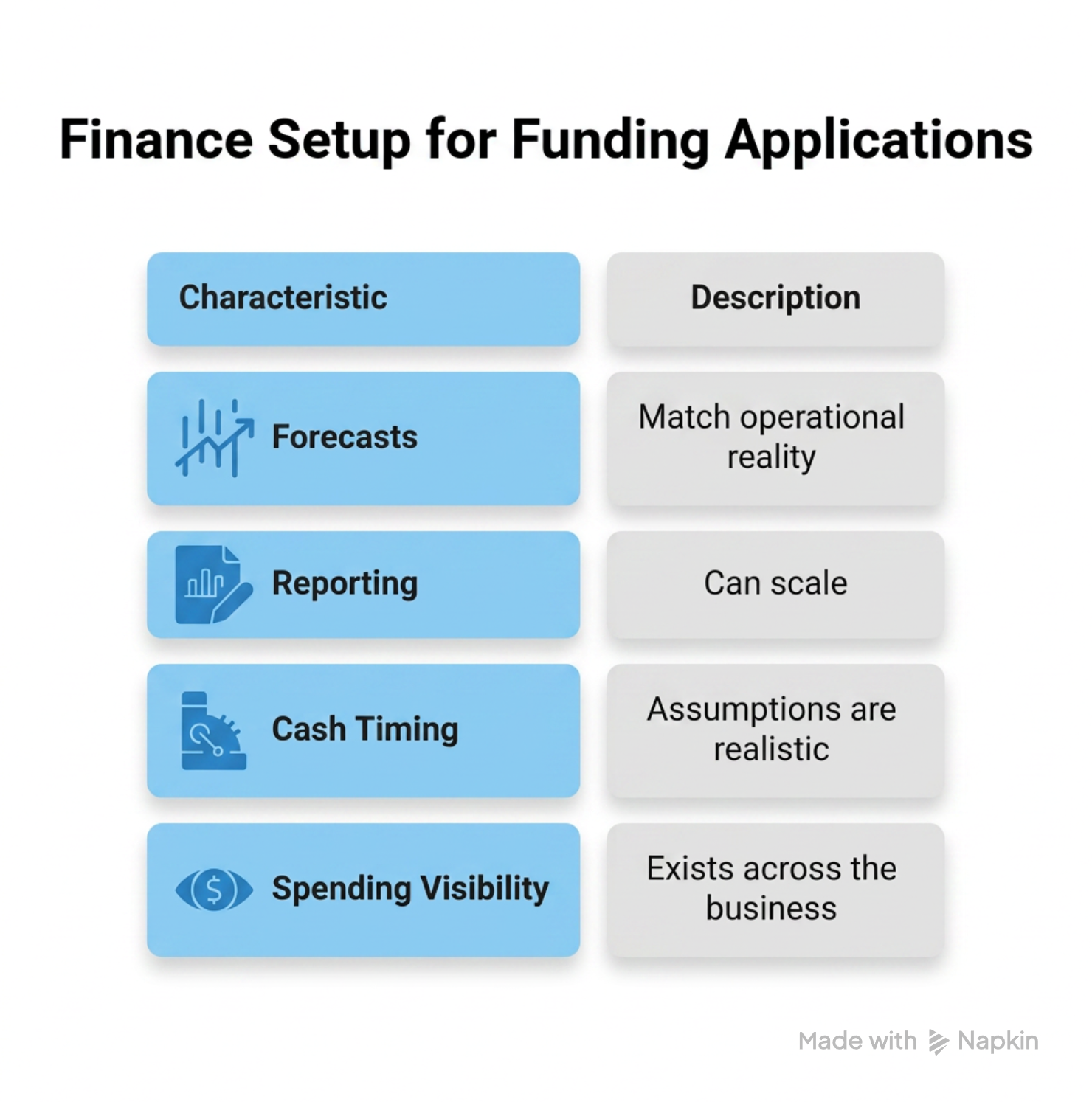
Funding applications become significantly stronger when the finance system behind them already works properly.
Build a finance system that can actually support funding
Many startups focus on getting the funding approved, then realise later that the reporting, forecasting, and operational tracking behind the business are still fragmented.
That usually creates:
inconsistent reporting
unreliable runway visibility
manual investor updates
difficulty tracking spend against milestones
operational confusion as the business grows
Before your next grant or funding application, review whether your finance setup can actually handle the complexity that comes after approval.
At Accountup, we help startups build finance systems that support:
funding readiness
investor reporting
forecasting
burn and runway visibility
structured financial control
If your reporting still depends on spreadsheets, disconnected tools, or manually rebuilding updates every month, this is usually the stage where the system underneath the business needs to change.


