
Why finance breaks between seed and Series A (and what to fix first)
Seed went well. Headcount doubled. Revenue grew, but so did AWS bills, agency contractors, and "temporary" spreadsheet models. Eighteen months later, Series A diligence asks for monthly financials and the numbers in the deck do not match Xero.
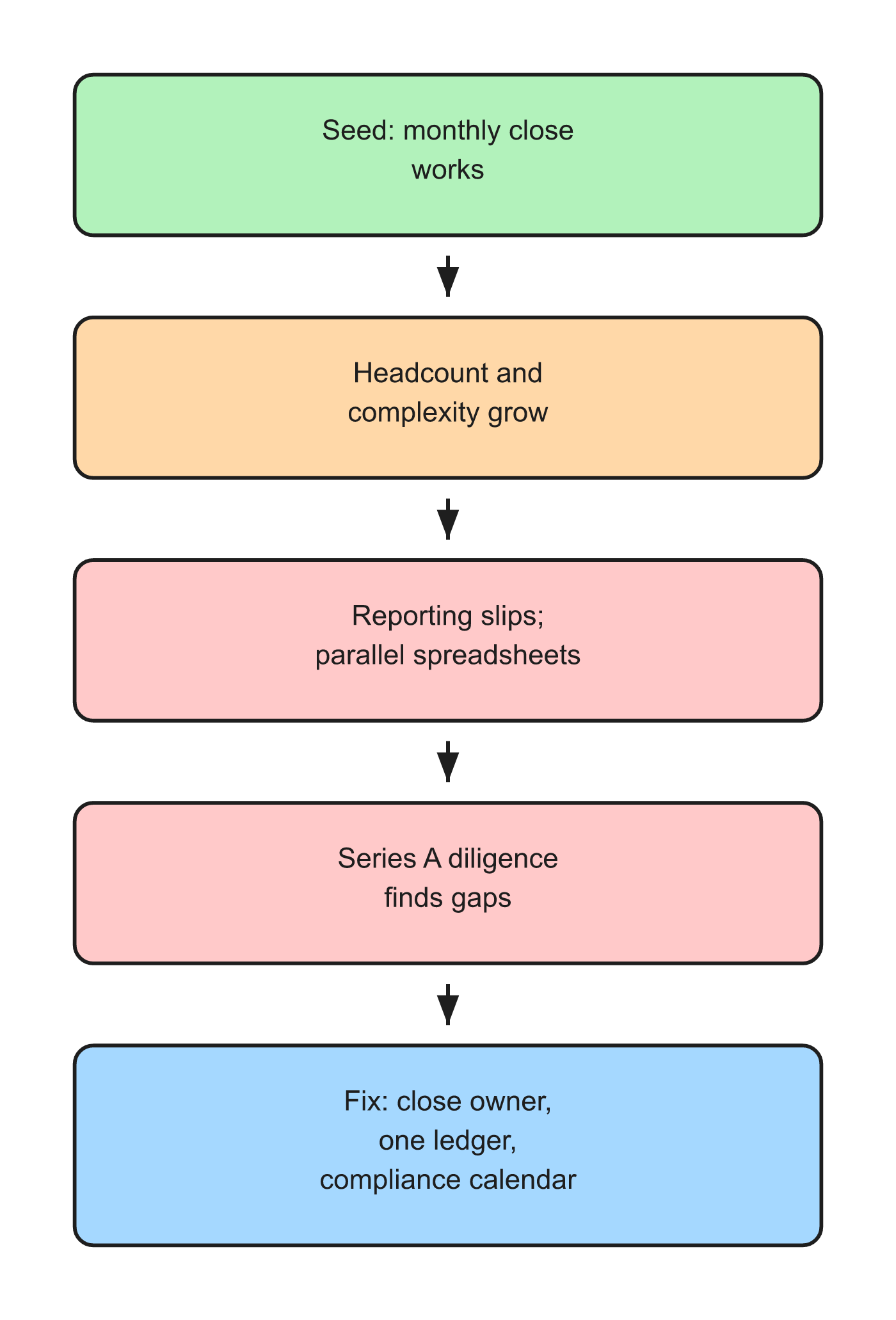
Finance rarely breaks in one day. It drifts after seed when growth outpaces the systems that worked at twelve people.
Why does finance break after seed?
At seed you had one bookkeeper, one Xero file, and a founder who eyeball-checked cash weekly. Between seed and Series A you added payroll, VAT, options, maybe a second entity, and board reporting without upgrading the operating model.
The ledger is still running. The finance ops layer stopped keeping up.
Typical breakdown path to Series A
SYSTEM INSIGHT / NEXT STEP
Make the next move with clarity.
If this issue is already showing up in reporting, runway, or team decisions, the next move is usually clearer with a structured finance view.
Failure mode 1: Reporting drift
Monthly investor updates slip to "when we have time." Management accounts rebuild from scratch each quarter.
Fix first: one monthly close date and one owner. Close, pack, send. Same week every month.
Failure mode 2: Spreadsheet sprawl
Runway lives in a model. Board sees a different burn in the deck. Xero has a third version.
Fix first: single source of truth in the ledger. Spreadsheets for scenario planning only, fed from exported actuals.
Failure mode 3: Payroll and benefits complexity
First hires were simple PAYE. Then pensions, cycle-to-work, parental leave policies, and off-cycle adjustments. Payroll journals do not post cleanly to the P&L.
Fix first: payroll integration reviewed monthly. Reconcile employer costs to budget lines investors already track.
Failure mode 4: VAT and tax calendar overload
VAT registration mid-journey without updating close process. CT600 and Companies House deadlines stack on top of board prep.
Fix first: compliance calendar with named owners. See missed VAT deadlines for what happens when VAT slips.
Failure mode 5: Cap table and option mess
EMI grants approved in email. Companies House share register lags. Diligence finds missing board resolutions.
Fix first: cap table reconciled to statutory records before you need a data room. See fundraising diligence checklist.
Failure mode 6: Wrong hire at the wrong time
A full-time finance manager hired at 15 employees without process to manage. Or no hire at all at 35 employees still on founder DIY.
Fix first: outsource through scale, add fractional CFO for fundraise, hire in-house when daily finance work justifies it.
What to fix first (priority order)
Priority | Fix | Why |
1 | Bank reconciliation and clean ledger | Everything else is built on this |
2 | Monthly close by day 10 | Stops reporting drift |
3 | One investor/board reporting pack | Ends duplicate numbers |
4 | Compliance calendar (VAT, PAYE, CH, CT600) | Prevents public penalties |
5 | Cap table and share records | Series A blocker if wrong |
6 | R&D and contract documentation | Enquiry and diligence risk |
Do not start with a new dashboard tool. Start with close discipline.
Signs you are heading for a Series A finance crunch
Founder is the only person who knows how burn is calculated.
Last three investor updates used different MRR definitions.
You cannot produce last month's P&L within 48 hours.
HMRC or Companies House correspondence is unanswered.
Board packs and investor emails disagree on cash.
Review 12 investor-ready signals six months before you plan to raise.
In practice
Seed installs the ledger. Series A tests whether you built finance ops on top of it.
Companies that fix close, reporting, and compliance early raise faster. Companies that wait pay clean-up fees and lose momentum.
FAQs
Why do startup finances get messy after seed?
Growth adds payroll, VAT, reporting audiences, and headcount without upgrading month-end process and ownership.
When should we upgrade finance ops after seed?
When monthly reporting becomes inconsistent, or before you start Series A prep (ideally 6 to 12 months earlier).
What is the first thing to fix before Series A?
Reconciled books and a reliable monthly close producing one set of numbers for board and investors.
Is Series A diligence harder than seed diligence?
Usually yes. Request lists are longer and historical consistency matters more.
Should we hire a CFO before Series A?
Often a fractional CFO plus outsourced ops is enough until post-Series A complexity.
**Series A in the next 12 months?** Talk to an Expert or see pricing.


