
Most founders can tell you their hiring plans, fundraising targets, and growth goals for the year ahead.
Far fewer can confidently answer questions such as:
What filings are due next?
Have we submitted everything we need to?
What HMRC and Companies House deadlines are coming up?
What should we be preparing for now?
As startups grow, these questions become more important.
Annual accounts, confirmation statements, Corporation Tax, VAT returns, payroll submissions, P11D reporting, and Companies House identity verification requirements can all sit alongside the day-to-day work of building the company.
Why Does This Become Harder As Startups Grow?
In the early stages, compliance is usually more straightforward.
There are fewer transactions, fewer employees, and fewer reporting requirements. Founders can often manage the basics with a calendar reminder or regular check-in with their accountant.
Growth changes the picture.
A funding round may introduce investor reporting expectations.
Hiring creates payroll obligations.
Revenue growth may trigger VAT registration.
Employee benefits may create P11D or payrolling benefit obligations.
New directors and people with significant control may also need to complete Companies House identity verification.
Each development is positive for the business, but each one can add another deadline, process, or responsibility that needs attention.
The Compliance Challenge Many Founders Face
Most startups already have access to the information they need.
The difficulty is bringing it together into a format that is easy to understand and act on.
Important information can sit across:
Companies House records
HMRC accounts
Accounting software
Payroll platforms
Internal spreadsheets
Calendar reminders
Accountant emails
As a result, founders often find themselves checking multiple places to answer what should be simple questions.
SYSTEM INSIGHT / NEXT STEP
Make the next move with clarity.
If this issue is already showing up in reporting, runway, or team decisions, the next move is usually clearer with a structured finance view.
What Filings Should Startups Typically Keep Track Of?
The exact requirements vary between companies, but many UK startups need visibility over some combination of the following:
Filing requirement | What it relates to |
Annual accounts | Filed with Companies House. Private companies usually file annual accounts within 9 months of the financial year end. First accounts usually have a different deadline. |
Confirmation statement | Filed with Companies House at least once every 12 months. It confirms that key company information is up to date. |
Corporation Tax | Corporation Tax is usually payable 9 months and 1 day after the accounting period ends. The Company Tax Return is usually due 12 months after the accounting period ends. |
VAT returns | Required for VAT-registered businesses. VAT returns and payments are usually due 1 month and 7 days after the VAT period ends, although some schemes have different deadlines. |
PAYE / RTI payroll submissions | Required when running payroll. Full Payment Submissions are normally sent to HMRC on or before each payday. |
P11D / benefits reporting | May apply where taxable employee benefits or expenses are provided and not fully payrolled. P11D and P11D(b) reporting is normally due by 6 July after the tax year. |
Companies House identity verification | Directors and people with significant control may need to verify their identity under Companies House requirements. |
Some of these obligations are annual. Others are monthly, quarterly, or linked to payroll dates.
As startups grow, the number of reporting requirements often grows with them.
Why Visibility Matters
Most compliance pressure develops gradually rather than all at once.
A deadline may be recorded but not reviewed regularly. Preparation work may begin later than expected. Supporting information may need to be gathered at short notice. Multiple obligations can end up falling within the same period.
This creates pressure because compliance work competes with other priorities such as fundraising, hiring, customer delivery, and product development.
A clear view of upcoming obligations helps founders:
Plan ahead with more confidence
Prioritise upcoming deadlines
Reduce last-minute administrative work
Allocate preparation time more effectively
Stay organised as the business grows
For growing startups, visibility creates more time to prepare and fewer surprises along the way.
That Is Why We Launched AccountUp Check
At AccountUp, we work with startups navigating growth, hiring, investor reporting, compliance requirements, and increasing financial complexity.
One thing we noticed repeatedly was that founders wanted a simple way to understand their current filing position.
Before thinking about reporting systems, finance processes, or forecasting, many founders wanted answers to a few practical questions:
What is due next?
What has already been filed?
What deadlines are approaching?
What does the next year look like?
That is why we launched AccountUp Check.
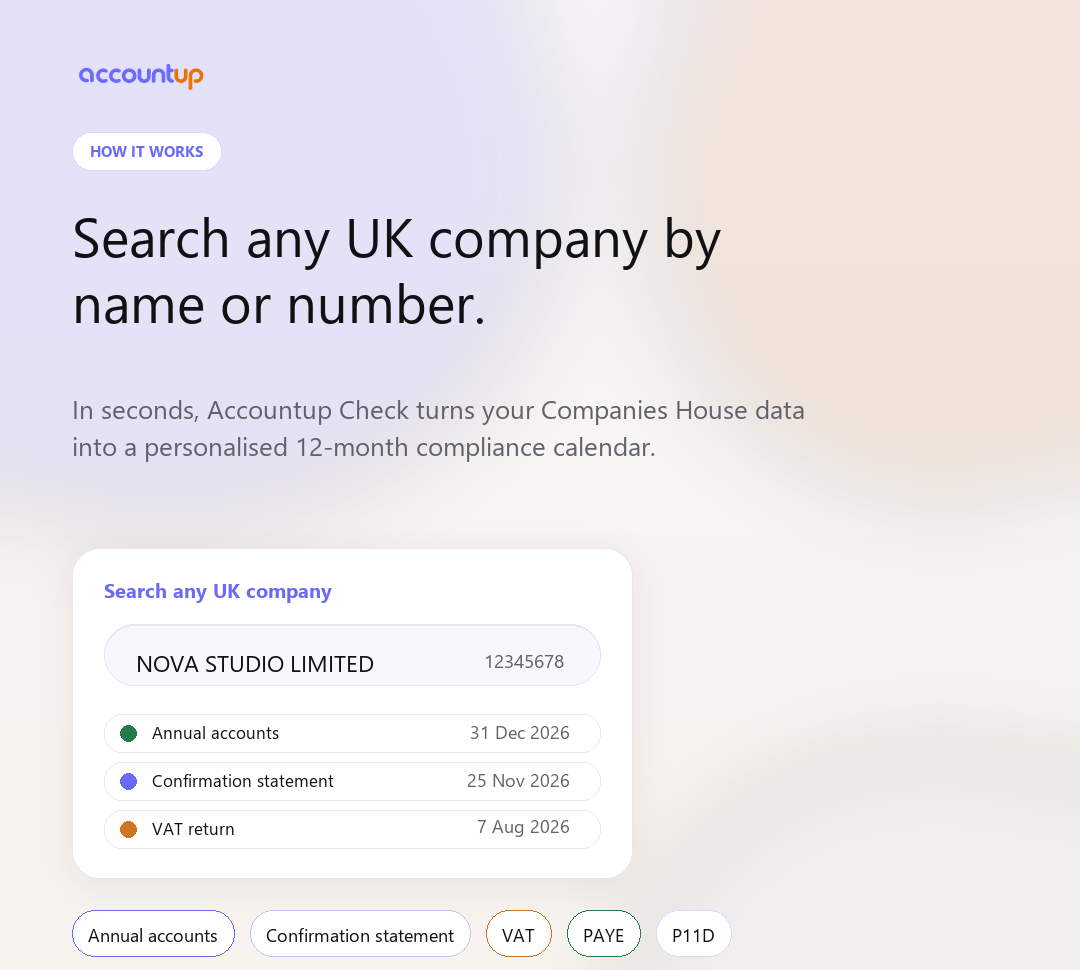
It is a free tool that helps founders quickly understand their company’s filing position.
By searching a UK company, founders can:
View upcoming Companies House filing deadlines
Review filing history
Check company information
Generate a personalised 12-month compliance calendar
See key deadline categories such as annual accounts, confirmation statements, VAT, PAYE, and P11D
Export deadlines to Google Calendar, Outlook, Apple Calendar, or PDF
The goal is simple: Help founders spend less time searching for information and more time building their business.
A Simple Starting Point For Better Visibility
As startups grow, finance becomes more than bookkeeping and compliance.
Founders need visibility into reporting, cash flow, payroll, forecasting, runway, investor expectations, and statutory obligations.
Many of those challenges become easier to manage when there is a clear understanding of what obligations exist and when they need attention. AccountUp Check was built to provide that starting point.
A simple way for founders to see what needs filing, what has already been filed, and what may be coming next over the next 12 months.
Check your company on AccountUp Check and see what your startup may need to file before the next deadline becomes urgent.
Please note: AccountUp Check is designed to support visibility, not replace professional advice. Filing obligations vary by company, VAT scheme, payroll setup, benefits, accounting period, and HMRC status.


