
TL;DR
UK Startups in 2026 should choose funding based on the project they want to deliver, not just what support is available.
The strongest routes are:
local and regional grants
energy-efficiency grants
digital and productivity support
rural and farming grants
Innovate UK competitions for innovation-led startups
apprenticeship, export, R&D tax relief, and debt finance support where relevant
The right route should match your sector, costs, cash position, and ability to track spend.
Which UK startup grants and funding routes are worth considering in 2026?
UK startup funding in 2026 depends on the business’s location, sector, project type, cash position, and evidence quality.
A manufacturer may benefit from equipment, energy, productivity, or regional growth support. A hospitality business may find local or energy-efficiency grants more relevant. A professional services firm may look at digital adoption, training, or export support. An innovation-led startup may be better suited to Innovate UK competitions or R&D tax relief.
This guide focuses mainly on grants, but also includes selected non-grant routes that startups often compare with grants. These include tax reliefs, export finance, loan guarantees, and training support. They are useful, but they work differently from grant funding.
GOV.UK’s business finance support tool lists support schemes for startups, including grants, loans, advice, and regional programmes.
The useful question is simple: What business action are we trying to fund?
SYSTEM INSIGHT / NEXT STEP
Make the next move with clarity.
If this issue is already showing up in reporting, runway, or team decisions, the next move is usually clearer with a structured finance view.
UK startup grants and funding routes worth considering in 2026
Route | Type | Worth considering if... | What to check first |
Local and regional grants | Grant | You are investing locally, creating jobs, improving premises, or buying equipment | Location rules, quotes, timeline, local benefit |
Energy-efficiency grants | Grant / subsidy | You have high energy costs, old equipment, or premises upgrades | Current costs, savings, eligible spend, VAT |
Digital and productivity support | Grant / support | You are improving systems, automation, workflows, or reporting | Time saved, errors reduced, capacity improved |
Rural and farming grants | Grant | You operate in agriculture, forestry, food production, or rural enterprise | Sector rules, location rules, eligible items |
Innovate UK competitions | Innovation funding | You are developing a new product, process, technology, or technical solution | Scope, collaboration rules, costs, reporting |
Apprenticeship and training funding | Training support | You are hiring, training, or upskilling staff | Training cost, supervision time, wage cost |
Export finance and trade support | Finance / guarantee / insurance | You sell overseas or are preparing for export orders | Working capital, credit risk, insurance, currency |
R&D tax relief | Tax incentive | You are solving scientific or technological uncertainty | Technical evidence, time records, costs |
Growth Guarantee Scheme | Debt finance | You need borrowing support for growth, cash flow, or assets | Affordability, lender criteria, repayment ability |
This table should be the first filter. A route is worth considering when it fits the project, the numbers, and the timing.
1. Local and regional grants
Local and regional grants are often the most practical starting point for small startups. They usually support local value, such as job creation, premises improvement, equipment investment, high-street activity, production capacity, or regional growth.
This route is worth considering if your business is planning to:
buy equipment
improve premises
create or protect jobs
expand locally
increase production or service capacity
For many small startups, this route is more relevant than national innovation funding because the project is practical and local.
2. Energy-efficiency grants
Energy-efficiency grants are worth considering when the business has high utility costs, older equipment, inefficient premises, or a low-carbon upgrade plan.
These grants can support:
LED lighting upgrades
heating or insulation improvements
energy-efficient machinery
waste reduction systems
low-carbon equipment
production process improvements
Ofgem explains that government schemes can offer loans, grants, or subsidised energy-saving measures to help small businesses reduce environmental impact.
The strongest case is measurable. The business should be able to show current energy costs, expected savings, supplier quotes, and a realistic payback period.
3. Digital and productivity support
Digital and productivity support is useful when the business is improving how work gets done.
This route fits startups dealing with:
manual admin
stock errors
duplicated data entry
slow reporting
poor customer follow-up
disconnected systems
spreadsheet-heavy workflows
A good project explains the operational problem, the system being introduced, and how the change improves productivity, accuracy, capacity, or control.
This is especially relevant for startups that have outgrown informal processes and need cleaner systems before the next stage.
4. Rural, farming, and equipment grants
Rural, farming, and equipment grants are worth considering when the business fits a specific sector or location rule.
They may support:
farming equipment
forestry activity
food production
rural enterprise
environmental improvements
productivity upgrades
animal health and welfare
waste or slurry management
This route is worth considering when the project has a clear operational outcome, such as improving equipment, increasing productivity, reducing waste, or strengthening rural business activity.
5. Innovate UK competitions
Innovate UK competitions are worth considering when the startup is developing a new product, process, technology, or technical solution.
Smart Grants were paused from January 2025 while Innovate UK developed more tailored support. Innovate UK Business Connect also confirmed there would be no Smart rounds in the 2025/26 financial year.
This route fits startups that can explain:
what is genuinely innovative
what technical challenge exists
why the project matters commercially
what costs are eligible
whether collaboration is required
how progress will be reported
A normal equipment upgrade, website rebuild, or software subscription usually fits better under local, digital, productivity, or energy support.
Other startup funding routes worth considering
The next routes are useful, but they should be separated from grants because they work differently.
6. Apprenticeship and training funding
Apprenticeship and training funding is worth considering when the business has a real staffing or capability need. GOV.UK published apprenticeship funding rules for 2026 to 2027, applying to apprenticeships starting between 1 August 2026 and 31 July 2027.
This route can suit startups that are:
hiring junior staff
upskilling an existing team
building technical capability
training supervisors
developing role-specific skills
The business still needs time to supervise, manage, and retain the person being trained.
7. Export finance and trade support
Export finance and trade support are worth considering when an startup sells overseas or is preparing for export orders.
This route may support businesses that need help with:
fulfilling larger international orders
protecting against non-payment
managing working capital
supporting buyer finance
entering new export markets
Exporting can look profitable while still creating cash pressure through payment terms, shipping timelines, customer credit risk, currency movement, and stock requirements.
8. R&D tax relief
R&D tax relief is relevant for companies carrying out qualifying technical work. HMRC says qualifying R&D must seek an advance in a field of science or technology, and only companies chargeable to UK Corporation Tax can qualify.
This can apply to some:
software development
engineering projects
manufacturing improvements
product development
AI projects
technical process improvements
The key point is evidence. A claim becomes stronger when the business records the uncertainty, work completed, people involved, time spent, costs, failed attempts, and technical decisions while the work is happening.
9. Growth Guarantee Scheme and debt finance
The Growth Guarantee Scheme is worth considering when an startup needs debt finance for growth, investment, cash flow, or assets.
The British Business Bank says the scheme can generally support facility sizes of up to £2 million and gives lenders a 70% government-backed guarantee. The borrower remains 100% liable for the debt, so affordability must still be reviewed carefully.
This route may suit startups that need finance for:
equipment
working capital
stock
expansion
asset finance
invoice finance
This is borrowing support. It can improve access to finance, but it does not remove repayment responsibility.
Which route should a startup prioritise first?
The first route to prioritise is the one that matches a project the business is already ready to deliver.
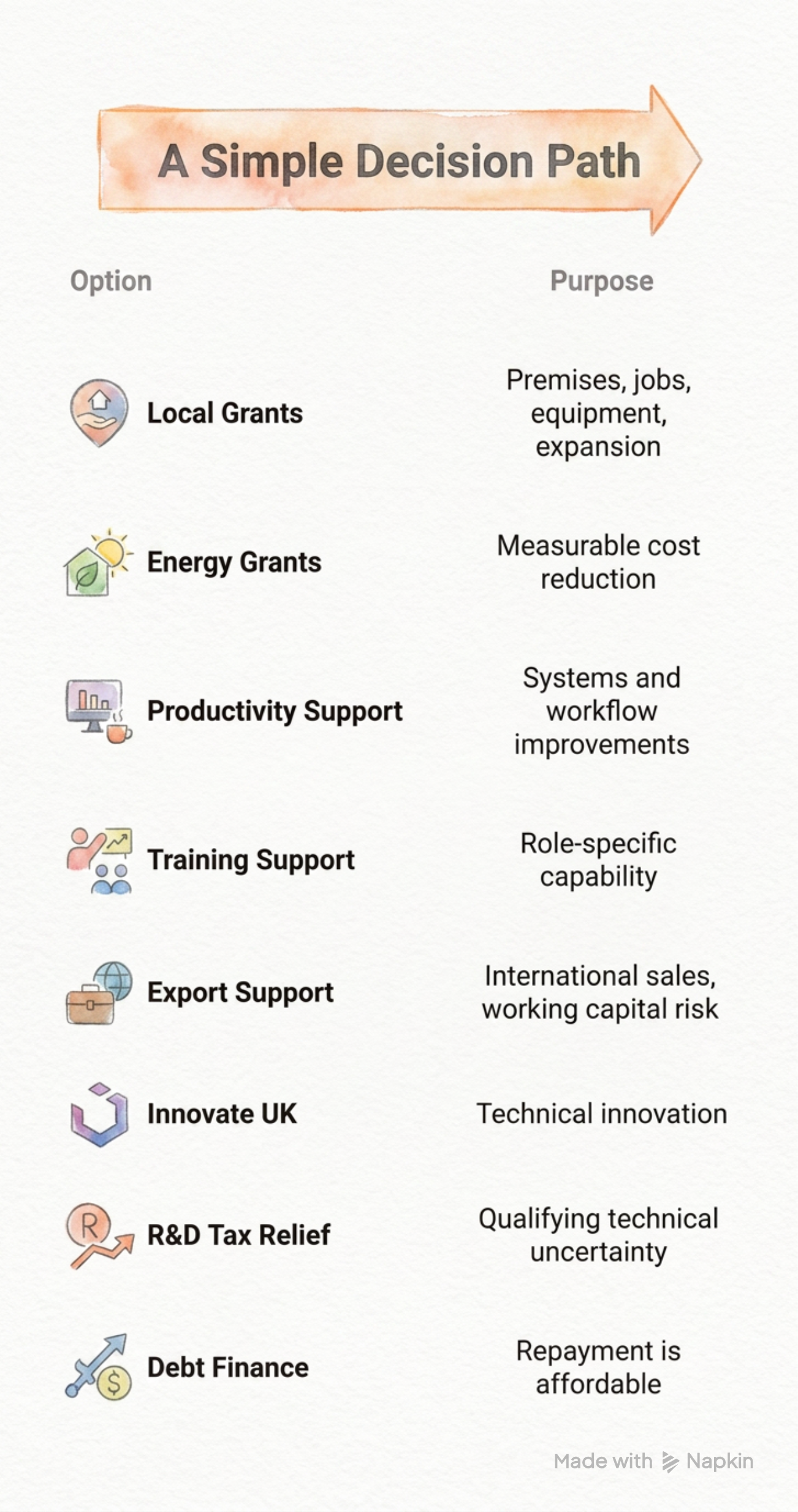
Before choosing, check eligibility, cash timing, evidence, reporting, VAT treatment, and repayment obligations.
Get your SME grant-ready before you apply
Before you apply for a grant or commit to any funding route, make sure your numbers can support the application.
Funding can help your business invest in equipment, energy savings, training, exports, systems, or innovation. But once funding is involved, you need clean records, clear cost tracking, and reliable cash visibility.
At Accountup, we help SMEs build finance systems that support:
clean bookkeeping
structured reporting
cash flow visibility
project cost tracking
grant and funding readiness
Start with a finance readiness review before you apply!
We will help you check whether your records, cash flow, project costs, and reporting setup are strong enough to support the application and manage the funding after approval.


