
Month-end close checklist for UK startups
The month-end close is the monthly reset that turns bank feeds and invoices into numbers you can trust. For UK startups, it is also the bridge between daily bookkeeping and the management accounts pack your board expects.
Miss the close and you fly blind on burn. Rush it and you carry errors into fundraising diligence.
What is a month-end close for startups?
A month-end close is the set of reconciliations, adjustments, and reviews that finalise one month's financial records so leadership can report cash, profit, and runway with confidence.
Year-end accounts come later. The month-end close is the operating rhythm that keeps investor updates honest.
Month-end close checklist at a glance
The diagram below shows the standard sequence. Details for each step follow.
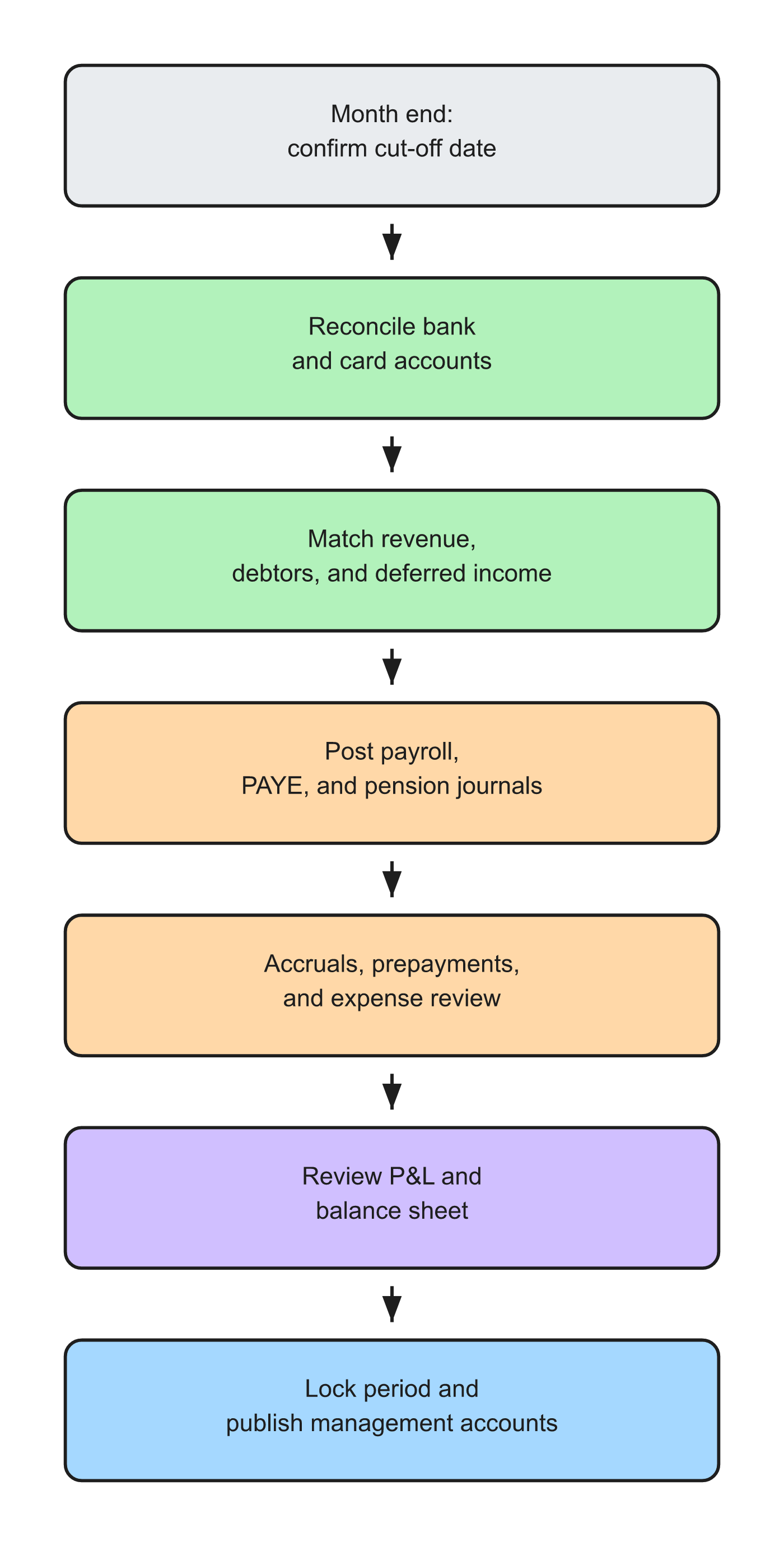
Most seed to Series A UK startups aim to close within 10 to 15 working days of month end. Faster is better if data quality holds.
SYSTEM INSIGHT / NEXT STEP
Make the next move with clarity.
If this issue is already showing up in reporting, runway, or team decisions, the next move is usually clearer with a structured finance view.
1. Confirm cut-off date
Agree when the month "stops" for journals. After cut-off:
No backdated expenses without a documented reason
Sales invoices for the month are issued or deferred correctly
Founder card transactions are submitted
If you are VAT registered, cut-off affects which VAT period captures the supply. Align with your accountant before changing habits mid-quarter.
2. Reconcile bank and card accounts
Match every bank and card account in Xero (or your ledger) to statements:
Check | Done? |
All bank feeds imported | |
Unexplained items cleared or queried | |
Stripe/Paddle balances reconciled to payouts | |
Founder expenses on correct entity |
Reconciliations are the foundation of an accurate close. For UK startups, separate company and personal accounts before you reconcile. Mixed flows are the most common close blocker.
3. Match revenue, debtors, and deferred income
For SaaS and subscription businesses:
Deferred revenue matches active subscriptions
Invoices raised match recognised revenue for the month
Debtor ageing reviewed (any invoice over 60 days flagged)
If you bill in USD but report in GBP, confirm FX rates are applied consistently.
4. Post payroll, PAYE, and pension journals
Item | Typical action |
Payroll run | Posted for the month |
PAYE/NI | Liability matches HMRC EPS view |
Pension | Employer contributions accrued |
Contractors | CIS status verified if construction sector |
Payroll errors compound. Fix them in the month they occur, not at year-end.
5. Accruals, prepayments, and expense review
Post adjusting journals for:
Accruals: costs incurred but not yet invoiced (hosting, contractors, legal)
Prepayments: annual software licences spread across months
Missing receipts: chase or write off with approval
Daily coding quality reduces accrual firefighting at month end. A 15-minute weekly expense review beats a three-hour scramble.
6. Review profit and loss and balance sheet
Sanity checks before you lock the period:
Revenue trend vs prior month and budget
Payroll and headcount align
Cash on balance sheet matches bank reconciliation total
No single suspense account growing unexplained
If something looks wrong, fix the transaction. Do not "journal it away" without a note.
7. Lock period and publish management accounts
Once reviewed:
Lock the accounting period (or agree no further journals without approval)
Produce the management accounts pack (P&L, balance sheet, cash, budget vs actual, KPIs, commentary)
Share with leadership or board on your agreed cadence
The close is only complete when someone can read the pack and understand what changed.
UK startup month-end close mistakes
Closing in spreadsheets instead of the ledger. Excel summaries drift from Xero. The ledger is the source of truth.
Skipping close because you are pre-revenue. You still have burn, cash, and payroll to track. Investors ask about runway even at seed.
Treating VAT and corporation tax as year-end surprises. Build monthly estimates into the pack if material.
Letting close slip past three weeks. Data goes stale. Board conversations shift from decisions to archaeology.
In practice
Traditional accountants may focus on year-end compliance. Growth startups need a repeatable monthly close tied to reporting and compliance.
AccountUp closes books on a fixed cadence, then feeds the same data into management accounts and investor-ready outputs. Founders get numbers they can use in board meetings, not just filings filed months later.
FAQs
How long should a month-end close take for a UK startup?
Most seed to Series A companies target 10 to 15 working days after month end. Simpler pre-revenue startups can close faster if bank feeds and categorisation are clean.
What is the difference between bookkeeping and month-end close?
Bookkeeping is recording transactions. Month-end close is reconciling, adjusting, and reviewing those records so monthly reports are accurate and complete.
Do I need a month-end close if I use Xero?
Yes. Bank feeds do not replace reconciliations, accruals, payroll journals, or management review. Xero holds the data; the close process makes it reliable.
What accounts should startups reconcile every month?
At minimum: all bank and card accounts, payment processor balances (Stripe, etc.), payroll liabilities, and key balance sheet accounts (debtors, creditors, deferred revenue).
When should a startup outsource month-end close?
Consider support when close consistently exceeds 15 working days, errors show up in board packs, or founders spend more than five hours per week on books. See our guide on outsourced bookkeeping.
**Want a close process that feeds your board pack automatically?** Talk to an Expert or review AccountUp pricing.


