
Management accounts template for UK startups: what to include
Investors do not fund spreadsheets. They fund confidence that you know where the money went, what changed this month, and how long the cash lasts. A management accounts pack is the monthly document that proves that, long before your year-end accounts land at Companies House.
For UK startups, the pack is internal. It is not filed with HMRC. But it is often the difference between a calm board meeting and a defensive one.
What are management accounts?
Management accounts are internal financial reports prepared monthly (or quarterly) that show performance, cash position, and variances against plan, so founders and boards can make decisions before year-end statutory accounts are final.
They are not the same as annual accounts. Year-end accounts look backward for compliance. Management accounts look forward for control.
SYSTEM INSIGHT / NEXT STEP
Make the next move with clarity.
If this issue is already showing up in reporting, runway, or team decisions, the next move is usually clearer with a structured finance view.
What should be in a UK startup management accounts pack?
A useful template for a seed to Series A startup usually contains six blocks. The diagram below shows how they fit together in a typical monthly pack.
Management accounts pack structure
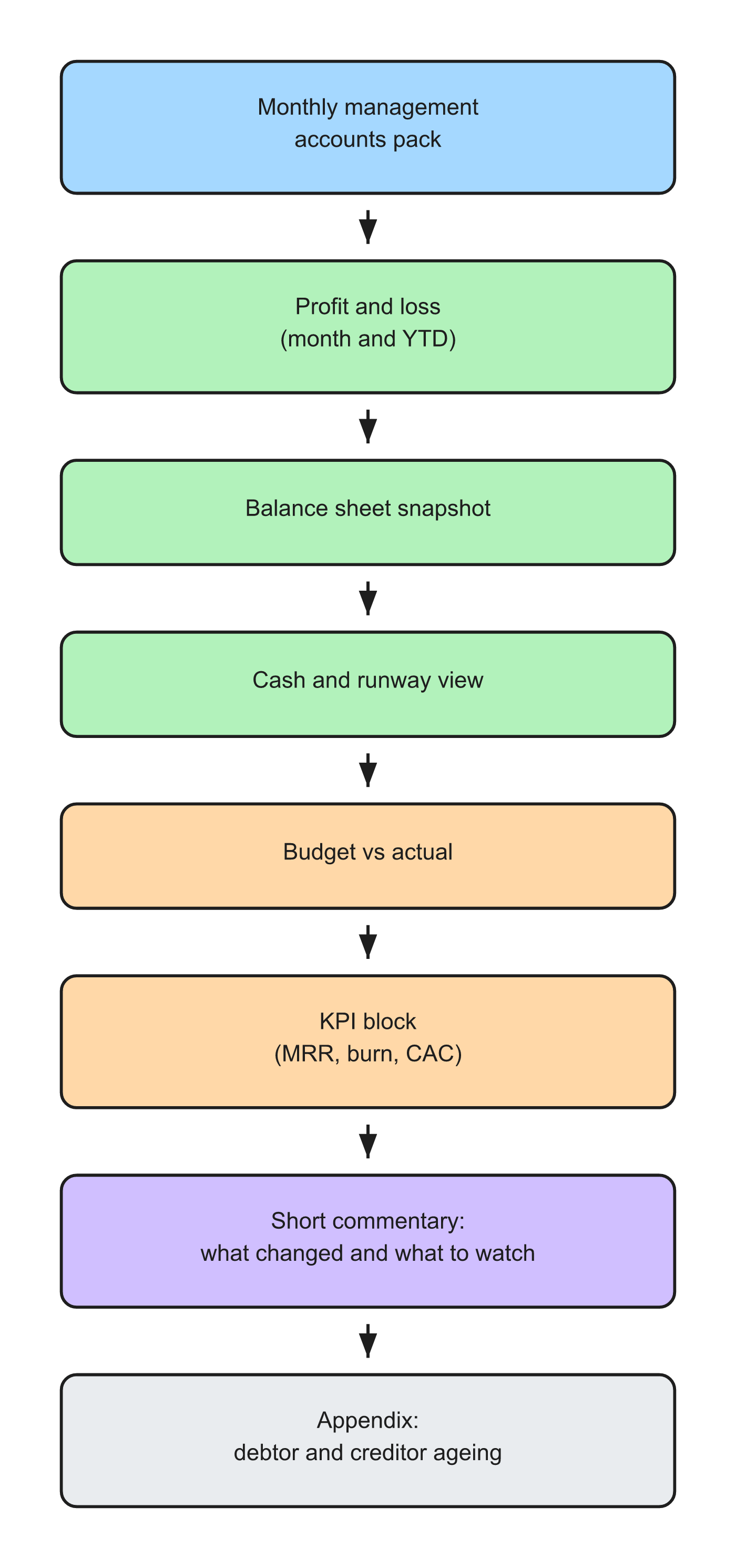
The six blocks in order:
Profit and loss (month and year-to-date)
Balance sheet snapshot
Cash flow or runway view
Budget vs actual (or forecast vs actual)
KPI block (metrics that match your model)
Short commentary (what changed and what you are watching)
Statutory accounts rarely include all six at the cadence boards expect. That is why founders build a separate pack.
1. Profit and loss (month and YTD)
Show revenue, cost of sales (if relevant), operating expenses by category, and EBITDA or net profit for:
The current month
Year to date
Optional: trailing three months for SaaS smoothing
Founders often over-customise categories each month. Lock your chart of accounts early and map board-friendly groupings (people, infrastructure, G&A, sales and marketing).
Investor-facing reporting guides treat the income statement as core material. UK template publishers stress gross and operating margins. For UK startups, show employer costs and R&D spend clearly if you claim R&D relief later.
2. Balance sheet snapshot
Include cash, receivables, payables, deferred revenue (if SaaS), debt, and equity. Boards use this to sanity-check whether P&L performance matches the balance sheet (for example, revenue growing but debtors ballooning).
You do not need a novel layout. You need the same layout every month.
3. Cash flow and runway
A P&L can look fine while cash drains. Add:
Opening and closing cash
Operating cash movement (even a simplified view)
Runway at current burn (months of cash left)
This is where Carta and Kruze-style investor content converges: cash truth beats accounting profit in board conversations.
4. Budget vs actual
Your management accounts template should compare plan to reality. Example (illustrative figures for a seed-stage SaaS startup):
Line | Budget | Actual | Variance | Notes |
Revenue | £42,000 | £38,500 | -8% | Two deals slipped to next month |
Payroll | £28,000 | £29,200 | +4% | New engineer started mid-month |
Hosting / COGS | £3,500 | £3,800 | +9% | Usage spike from new customers |
Sales and marketing | £12,000 | £14,500 | +21% | Paid campaign test; review ROI |
Variances without commentary are noise. Flag anything over 10% off plan or any single line that moves runway by a month or more.
5. KPI block (stage-appropriate)
Match metrics to your model. Common UK startup KPIs:
Stage | Examples |
Pre-seed / seed | MRR or revenue, burn, runway, headcount |
Post-raise | Gross margin, CAC payback, net revenue retention |
Series A prep | Rule of 40 components, sales efficiency, hiring plan vs actual |
Do not paste 40 metrics. Pick five to eight that your board already expects.
6. Commentary (half a page, maximum)
Answer four questions in plain English:
What improved vs last month?
What got worse?
What decision does this inform?
What do you need from the board (if anything)?
Kruze's investor-update content stresses regular, honest reporting. Your management accounts commentary is the internal draft of that discipline.
Management accounts template mistakes founders make
Rebuilding the pack from scratch each month wastes time. Use a fixed template linked to your accounting file.
Hiding bad months backfires. Boards forgive misses. They do not forgive surprises discovered in diligence.
Confusing company accounts with personal Self Assessment is common. The pack is for the limited company (or group). Personal tax sits elsewhere.
Waiting until year-end to fix categorisation catches up with you. If payroll, R&D, and revenue recognition are messy in July, your October board pack will be wrong too.
In practice
Traditional accountants often deliver annual accounts and occasional VAT returns. Growth startups need a monthly finance rhythm: close, pack, review, board.
Management accounts built from live books, not reconstructed spreadsheets, mean the same data powers investor updates, runway views, and compliance. Variances tie back to transactions your finance partner already reconciled. Boards see numbers that match diligence later.
FAQs
What is the difference between management accounts and annual accounts?
Annual accounts are statutory year-end reports filed with Companies House and used for corporation tax. Management accounts are internal, usually monthly, and built for decisions and board reporting.
How often should startups prepare management accounts?
Most VC-backed UK startups prepare them monthly, closed within 10 to 15 working days of month end. Some pre-seed companies use quarterly packs until headcount and burn complexity increase.
Do investors require a management accounts template?
Investors rarely mandate a specific template, but they expect consistent P&L, cash, runway, and KPIs each month after funding. A standard pack reduces friction in board meetings and diligence.
Can I use a spreadsheet template instead of my accounting software?
You can supplement with Excel, but the source of truth should be your accounting system (for example Xero). Manual-only templates break at scale and create version-control risk.
What should a pre-seed startup include if revenue is small?
At minimum: cash balance, monthly burn, runway, and a simple P&L. Add budget vs actual once you have a hiring or growth plan worth tracking.
**Need a monthly pack your board will actually read?** Talk to an Expert or start with the finance health score to see where your reporting gaps are today.


