
Financial stress appears before financial risk because founders lose visibility into short-term cash timing before the business is actually in danger. When upcoming obligations and incoming cash are not visible together, uncertainty rises even if there is still money in the bank.
This is common in early-stage startups where the business has started working, but the finance setup has not evolved into a system.
What is financial stress?
Financial stress is uncertainty about short-term cash timing, even when overall cash levels are still healthy.
It shows up when founders cannot confidently answer questions like:
What will cash look like in two weeks?
Which obligations hit before the next payments arrive?
Can we approve this spending without causing a squeeze?
Financial stress usually appears before any real financial risk exists.
Why do founders feel financial stress when cash is still available?
Founders feel financial stress when they cannot clearly see how upcoming obligations and incoming cash interact over time.
Common situations that trigger this include:
Payroll due in the next 7-14 days.
VAT payable at month end.
Customer invoices are still unpaid.
Software subscriptions renewing automatically.
None of these are problems on their own.
Stress appears when founders cannot see how these items overlap, sequence, and affect cash together.
For seed-stage founders balancing product, sales, and hiring, this lack of joined-up visibility creates pressure long before the business is actually at risk.
SYSTEM INSIGHT / NEXT STEP
Make the next move with clarity.
If this issue is already showing up in reporting, runway, or team decisions, the next move is usually clearer with a structured finance view.
What causes financial stress in startups?
Financial stress is usually caused by timing mismatches.
The most common mismatches are:
Area | What founders see | What actually happens |
Revenue | Revenue recorded this month | Cash received weeks later |
Payroll | Fixed monthly cost | Cash leaves on fixed dates |
VAT | Collected from customers | Paid before all invoices settle |
Subscriptions | Small recurring costs | Renew automatically across the month |
When these movements are not visible together, founders feel stretched even when the business looks profitable on paper.
This is especially common in startups relying on:
Manual spreadsheets.
Month-end accounting reports.
Disconnected finance tools.
When does financial stress usually start?
Financial stress usually starts after the business begins working.
It commonly appears when:
The team grows beyond just the founders.
Revenue becomes recurring rather than one-off.
Payroll and VAT become routine obligations.
At this stage, finance stops being a monthly check and starts influencing weekly decisions.
If the finance setup has not evolved into a system, founders feel the strain first.
Why don’t monthly financial reports reduce stress?
Monthly financial reports stop reducing stress because decisions are made between reporting cycles.
Founders regularly decide:
Whether to hire.
Whether to approve spending.
Whether to delay or accelerate payments.
These decisions happen while cash is actively moving.
Reports that only explain what already happened do not reduce uncertainty about what is about to happen.
This gap between reporting and reality is a major source of financial stress.
Why does financial stress usually sit with the founder?
Financial stress usually sits with the founder because financial context lives in one person’s head.
In many early-stage startups:
The founder remembers which invoices are late.
The founder knows which expenses are one-off.
The founder tracks upcoming obligations mentally.
When someone asks, “Can we afford this?”, the answer depends on the founder reconstructing information manually.
This creates stress even when the underlying finances are stable.
How is financial stress different from financial risk?
Financial stress and financial risk are related, but they are not the same.
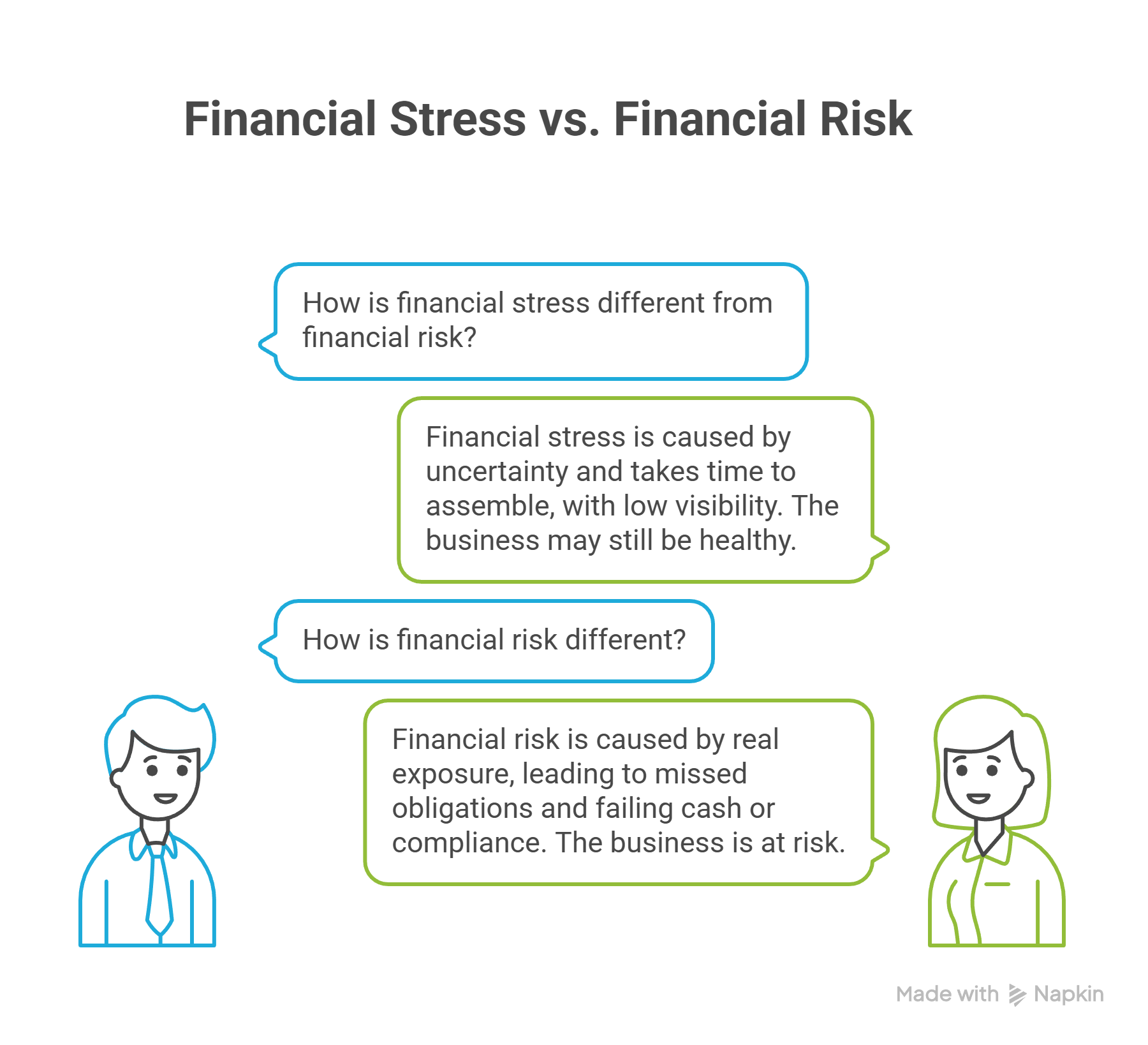
A startup can feel stressful while still being financially safe. Stress appears first because visibility disappears before cash does.
What reduces financial stress before it becomes financial risk?
Financial stress reduces when founders can see cash timing, obligations, and commitments without manual effort.
This typically happens when:
Cash, payroll, VAT, and expenses are visible together.
Financial data updates continuously.
Answers do not depend on one person’s memory.
For seed-stage founders who are not ready to hire a finance team, this usually means moving from spreadsheet-led finance to a system-led setup.
This is the stage Accountup is built for, a finance stack designed for startup founders that shows what is happening, what is coming next, and what needs attention, without adding headcount.
What should founders do when financial stress starts showing up?
When financial stress appears before financial risk, the next step is to check whether the finance setup still matches how the business now operates.
A practical way to do this is to:
Map how cash will move over the next 30-60 days.
Check whether payroll, VAT, and subscriptions are visible together.
Identify which answers still require spreadsheets or manual checking.
A finance stack assessment can help identify where visibility is breaking down, before stress turns into real risk.
Who is this relevant for?
This applies to:
Seed-stage startup founders.
Early SaaS and recurring-revenue businesses.
Founders managing payroll and VAT without a finance team.
Teams relying on spreadsheets or month-end reporting.
Key takeaway for founders
Financial stress is a signal that the finance setup has not kept pace with how the business now operates. Problems caused by timing and visibility rarely appear suddenly.
They build gradually as decisions become more frequent and consequences become more immediate.
Founders who act at this stage usually regain clarity by improving how financial information flows, long before financial risk becomes real.
If financial stress is rising, it is time to pressure-test your finance setup with Accountup.
TL;DR: Financial stress is more about early warning about visibility and less about stress.


