
Care home accounting in the UK: compliance and reporting basics
A care home is a regulated health and welfare business with payroll every month, fee income from councils and families, and CQC expectations on how you run the operation. Accounting is not just year-end accounts. It is how you prove the home is viable, staff are paid correctly, and records support inspections.
This guide covers the finance basics UK care providers need alongside clinical compliance. It is not legal or CQC advice.
What is care home accounting?
Care home accounting is the bookkeeping, payroll, VAT, management reporting, and statutory filings for a registered care provider. It tracks resident fees, staff costs, agency spend, and operating overheads so directors can manage cash and meet HMRC and Companies House obligations.
Founder-led care groups face the same Ltd company rules as tech startups, with different revenue patterns and heavier payroll.
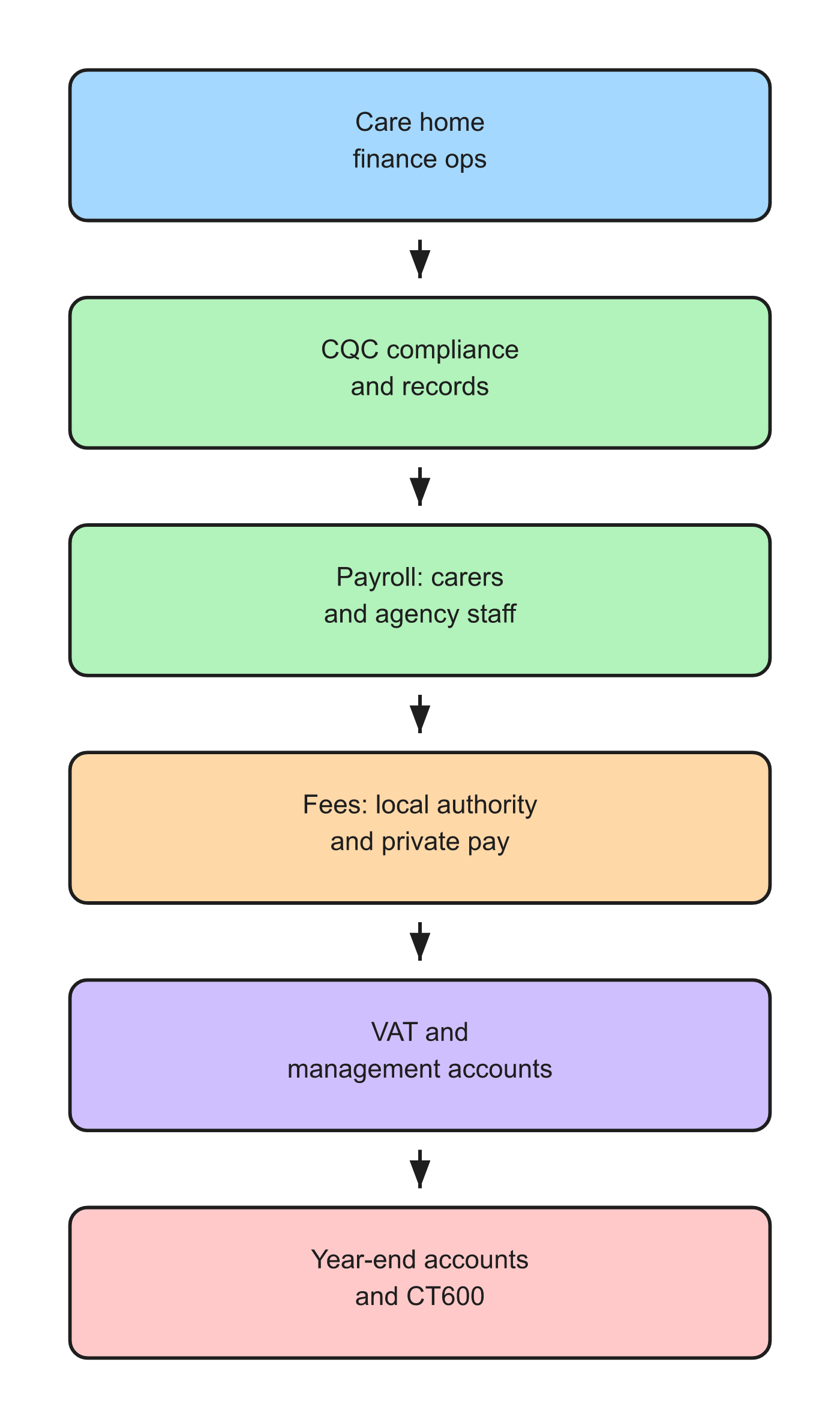
Finance and compliance stack for UK providers
SYSTEM INSIGHT / NEXT STEP
Make the next move with clarity.
If this issue is already showing up in reporting, runway, or team decisions, the next move is usually clearer with a structured finance view.
1. CQC and operational records
CQC inspects quality and safety, not your ledger. But financial chaos affects staffing, maintenance, and continuity of care, which inspectors notice.
Finance should support:
Staffing levels vs roster plans
Agency spend when vacancies spike
Maintenance and equipment budgets
Evidence that fees billed match care provided
Keep contracts with local authorities, private fee agreements, and top-up arrangements filed and linked to billing schedules.
2. Payroll for carers and agency staff
Payroll is often the largest cost line. UK care providers typically run PAYE with pensions auto-enrolment, holiday pay, and sleep-in or shift premiums depending on contracts.
Common payroll issues:
Misclassifying workers as self-employed when they are employees
Agency invoices not reconciled to rota systems
Overtime and bank holiday premiums miscalculated
Run payroll in software integrated with your ledger. Reconcile net pay to bank every month as part of month-end close.
3. Fee income: local authority and private pay
Revenue is often split between:
Local authority funded beds at agreed weekly rates
Private self-funders at higher rates
NHS continuing healthcare packages (where applicable)
Recognise revenue consistently with contracts. Council payments may lag invoicing. Track debtors by funder, not one blended total.
Weekly fee rates and void weeks (empty beds) directly affect cash. Management accounts should show occupancy and fee mix, not only accounting revenue.
4. VAT in care settings
Many care services are VAT exempt or outside scope when they qualify as welfare services. Some ancillary income (cafes, room hire, non-care services) may be standard-rated.
Get VAT treatment wrong and you undercharge for years or overclaim input VAT HMRC disallows.
If registered for VAT, apply the same deadline discipline as any business. See missed VAT return deadlines.
5. Management accounts for care groups
Directors need monthly visibility:
Occupancy and fee income by home
Staff vs agency cost per home
EBITDA or surplus before rent and central costs
Cash and short-term creditor pressure
Management accounts for care groups often include site-level P&Ls, not only consolidated group numbers.
6. Year-end accounts and CT600
Year end brings Companies House accounts and HMRC CT600 filings on the usual Ltd timelines.
Property-heavy groups may have rent, leases, and refurbishment capitalisation questions. Specialist care accountants help with sector norms.
Care home accounting mistakes
One Xero file for multiple homes with no site tracking.
Treating agency workers as a miscellaneous expense without weekly reconciliation.
Ignoring debtor ageing on council payments.
Directors taking dividends while PAYE/VAT arrears build.
No monthly management accounts until the bank calls.
In practice
Care providers benefit from finance ops built for payroll volume, funder billing, and monthly site reporting, not generic small-business bookkeeping.
Groups scaling from one home to three need chart of accounts and reporting designed for multi-site early, not after the second acquisition.
FAQs
Do care homes need VAT registration?
Depends on taxable turnover and which services you supply. Many care services are exempt, but ancillary income can trigger registration. Take advice on your fee mix.
What accounting software do UK care homes use?
Often Xero or similar with payroll integrations and site tracking via reporting classes or separate tracking categories.
How often should a care home produce management accounts?
Monthly is standard for groups with payroll pressure and variable occupancy.
Is care home accounting different from startup accounting?
The Ltd company rules are the same. Revenue mix, payroll complexity, and regulatory context differ.
What records do CQC inspections expect from finance?
CQC focuses on care quality, but financial sustainability and staffing support operational compliance. Keep payroll, agency, and maintenance records organised.
**Care provider needing payroll, VAT, and monthly reporting in one rhythm?** Talk to an Expert or see pricing.


