
You need an accountant when your priority is compliance and accurate records.
You need CFO-level support when your priority is planning, trade-off decisions, and capital allocation.
You need a stronger finance system when your priority is better visibility, process consistency, and faster reporting.
Most founders pick the wrong one because they are solving symptoms, not the underlying gap.
Why this decision becomes confusing
This usually shows up after:
first hires
first meaningful revenue
or right after raising funding
You start asking:
“Why don’t I have clear numbers?”
“Why does everything take so long?”
“Why do I still feel blind even with an accountant?”
In many cases, this is a systems, process, and ownership problem that gets mistaken for a hiring problem.
What each option actually does (in reality, not theory)
1. What an accountant solves
An accountant is primarily responsible for maintaining accurate financial records, ensuring compliance, and meeting reporting obligations.
What they actually handle
bookkeeping and reconciliations
VAT and tax filings
statutory accounts
compliance deadlines
Where it works well
early stage
low complexity
limited transactions
Where it breaks:
when you need real-time numbers
when decisions depend on current data
when you need forward-looking insights or decision support beyond standard reporting
SYSTEM INSIGHT / NEXT STEP
Make the next move with clarity.
If this issue is already showing up in reporting, runway, or team decisions, the next move is usually clearer with a structured finance view.
2. What a CFO solves
A CFO helps you make financial decisions when the business is already complex.
What they actually handle
forecasting and scenario planning
fundraising strategy
pricing, margins, and capital allocation
investor communication
Where it works well
growing complexity (often Series A and beyond)
multiple revenue streams
increasing need for planning, forecasting, and capital decisions
Where it breaks
if your underlying data is messy
if reporting is delayed
if there is no structured finance system
A CFO relies on the quality of underlying data. If inputs are inconsistent or delayed, even strong strategic guidance becomes less effective.
In earlier stages, many companies work with fractional CFOs to access strategic support without hiring a full-time executive.
3. What a finance system solves
A finance system helps structure, connect, and standardise financial data so reporting can be faster, more consistent, and easier to use for decision-making.
What it actually includes
connected tools (accounting, billing, payroll)
automated workflows
structured revenue and cost logic
near real-time visibility, with final accuracy dependent on closing processes
This is the type of setup modern finance tools aim to provide, including solutions like Accountup, which are designed to reduce fragmentation and improve visibility across workflows.
Where it works best
seed to pre-Series A
growing complexity
founders needing clarity without hiring a team
What it reduces dependence on
manual follow-ups
delayed reporting
disconnected tools
The real problem founders face
Most founders already have an accountant.
But still experience:
delayed reports
unclear numbers
manual investor updates
no visibility into burn or runway
This happens because:
accounting exists
but the system connecting everything does not
This is the gap many finance infrastructure tools aim to solve, including Accountup: reducing fragmentation, improving reporting consistency, and improving visibility without immediately expanding headcount.
Accountant vs CFO vs Finance System
Area | Accountant | CFO | Finance System |
Core role | Compliance | Strategy | Infrastructure |
Output | Reports | Decisions | Faster visibility |
Data freshness | Monthly/quarterly | Depends on inputs | Near real-time visibility / depends on source systems and closing processes |
Cost | Low to medium | Medium to high | Medium, with setup and integration costs |
When to use | Early stage | Scale stage | Growth transition stage |
Key limitation | No real-time insight | Needs clean data | Needs correct setup |
How to decide (simple decision rules)
You need an accountant if:
your main issue is tax and filings
your books are simple
you do not rely on real-time numbers
You need a CFO if:
your business has multiple revenue streams
you are preparing for or managing funding rounds
decisions involve complex trade-offs
You likely need a stronger finance system if:
you are chasing numbers every month
your financial reports feel delayed or unreliable
your tools are not connected
you still build investor updates manually
This is where many seed-stage founders find themselves.
In many companies, there is also a middle layer between accounting and CFO-level work, including finance managers or controllers who bridge reporting and decision support.
These roles often become important as complexity increases.
What founders usually get wrong
They try to solve a systems or finance-ownership gap with a hire alone.
hire an accountant → still no visibility
hire a CFO → still bad data underneath
The result:
more cost
same confusion
In practice, systems and expertise need to evolve together.
A basic level of financial ownership is required to set up the system correctly, and stronger systems then enable better strategic input over time.
What this looks like in practice
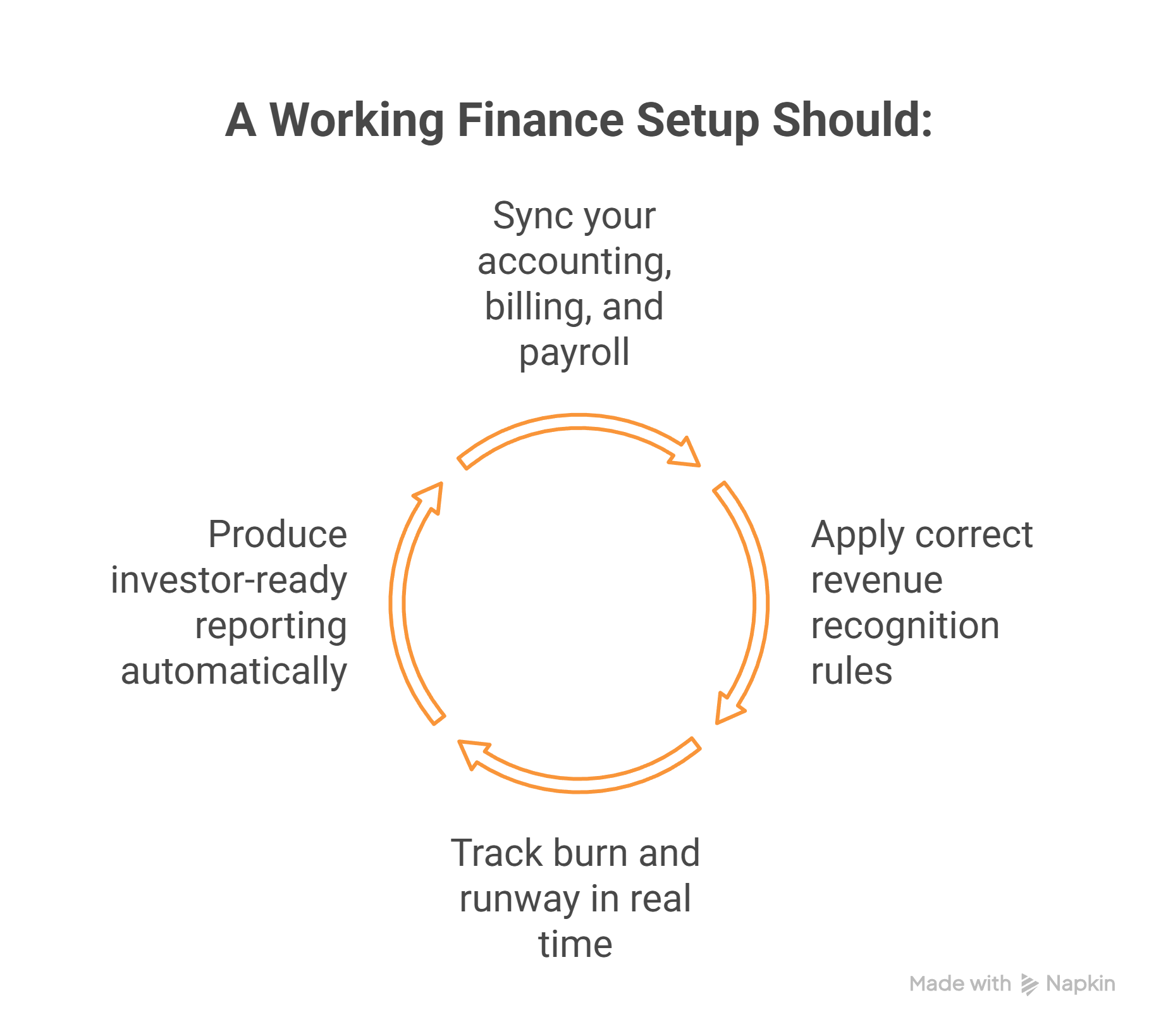
Less dependent on manual monthly effort, with more automated workflows and faster access to information, while still relying on periodic review and reconciliation.
However, periodic review, reconciliation, and adjustments still remain part of a reliable finance process.
What this means for you
This problem appears at a predictable stage:
after revenue starts
after hiring begins
after reporting starts to matter
At this point:
spreadsheets stop scaling
accountants are not enough
a full-time CFO is often too early
See exactly where your finance system is breaking
If you are at this stage, adding people alone usually will not fix the problem unless the underlying processes and systems improve as well.
The issue is how your finance system is set up.
What you need is a system that:
connects your tools end to end
applies the correct structure to your data
gives you real-time clarity on burn, runway, and performance
This is the kind of finance setup companies aim to build, whether internally or using tools like Accountup.
A well-designed finance setup significantly reduces manual follow-ups and makes numbers easier to access, though it still requires periodic review and validation.
If you want to understand what your finance setup should look like at your current stage, start with a simple assessment.
It will show you where your system is breaking and what needs to change.
TL;DR
The choice between an accountant, a CFO, and a finance system depends on the specific problem in your business.
Accountant = compliance.
Handles bookkeeping, filings, and keeps records accurate.
CFO = decision-making.
Supports forecasting, fundraising, and strategic financial choices.
Finance system = visibility and control.
Connects your tools, structures your data, and provides real-time numbers.
Many founders bring in support without addressing the underlying setup, which leads to continued confusion in numbers and reporting.
If your financials feel delayed, inconsistent, or difficult to rely on, the setup behind them needs attention.
A more effective approach is to build the right level of finance infrastructure and ownership together, then add specialised expertise as complexity increases.


